RM6393 Tactical Communication Systems (TacSys) Framework: Tender Documents Explained
Laura Danter
15 January 2026
Downloaded the TacSys tender pack, all 71 documents, and immediately thought, where do I even start?
Framework schedules, call-off schedules, joint schedules, general terms, attachments… The good news is this. Once you understand what each document is actually for, it all becomes much easier to navigate and you can save yourself a huge amount of time and frustration.
Let’s break it down.
Starting with the big picture
When a framework tender lands, you are not being sent dozens of documents for no reason.
They fall into three broad groups:
documents that explain the rules
documents that form the contract
documents you need to complete and submit
The confusion usually comes from the fact that they all arrive at the same time. Each document plays a different role, at a different stage, for a different purpose. Once you know which is which, everything starts to make sense.
Framework schedules – the rulebook
Framework schedules are the core rules of the framework.
They explain:
how the framework operates
how call-offs will be run (that’s the point where a buyer actually buys something through the framework)
what buyers and suppliers can and cannot do
how long the framework lasts
specific processes or templates
At tender stage
You need to read these carefully so you understand what you are signing up to.
Once you are on contract
You do not use them day to day, but they matter when there is a dispute or a “can we or can’t we” moment.
General Terms – the legal backbone
The General Terms are where the serious legal detail sits.
They usually cover:
liability
payment terms
termination
data protection
intellectual property
At tender stage
These are all about identifying risk. Are there any red flags or deal breakers for your business?
Once you are on contract
These suddenly matter a lot if something goes wrong. This is why lawyers pay close attention to them.
The Framework Award Form – the official handshake
The Framework Award Form is what formally confirms you are on the framework.
It summarises:
that you have been awarded a place
which lots you are on
when the framework starts
who the contracting parties are
key dates and procedures
At tender stage
You do not complete this. It is issued to you if you are successful.
Once your on contract
This is your proof that you are on the framework. It switches the contract on.
Call-off schedules – where the work happens
Call-off schedules do not really come to life until after you are on the framework.
They are used when a buyer actually wants to buy something from you and set out:
the specific requirement
delivery details
pricing
timelines
any changes to standard terms
At tender stage
You are usually reading examples to understand how work will be awarded later.
Once you are on contract
Each call-off becomes the contract for that specific piece of work.
Joint schedules – the shared conditions
Joint schedules are standard schedules reused across multiple frameworks.
Instead of rewriting the same rules every time, buyers create one set and uses them into lots of frameworks.
They usually cover more general things like:
definitions
information assurance
transparency
governance
At tender stage
You are not filling these in. Your job is to understand what is in them and make sure you are comfortable with how they apply to your business.
If you already work in the public sector, much of this will look familiar. Even so, it is still about checking nothing conflicts with how you operate.
Once on contract
They quietly apply to everything you do under the framework.
Attachments – the documents you actually work on
Attachments are the practical, working documents. They include things like:
questionnaires
pricing templates
technical responses
compliance tables
At tender stage
These are the documents you actively complete and upload. This is where most of your time goes.
Once on contract
These form part of the contract if you’re successful. See Framework Schedule 2.
Framework Schedule 2
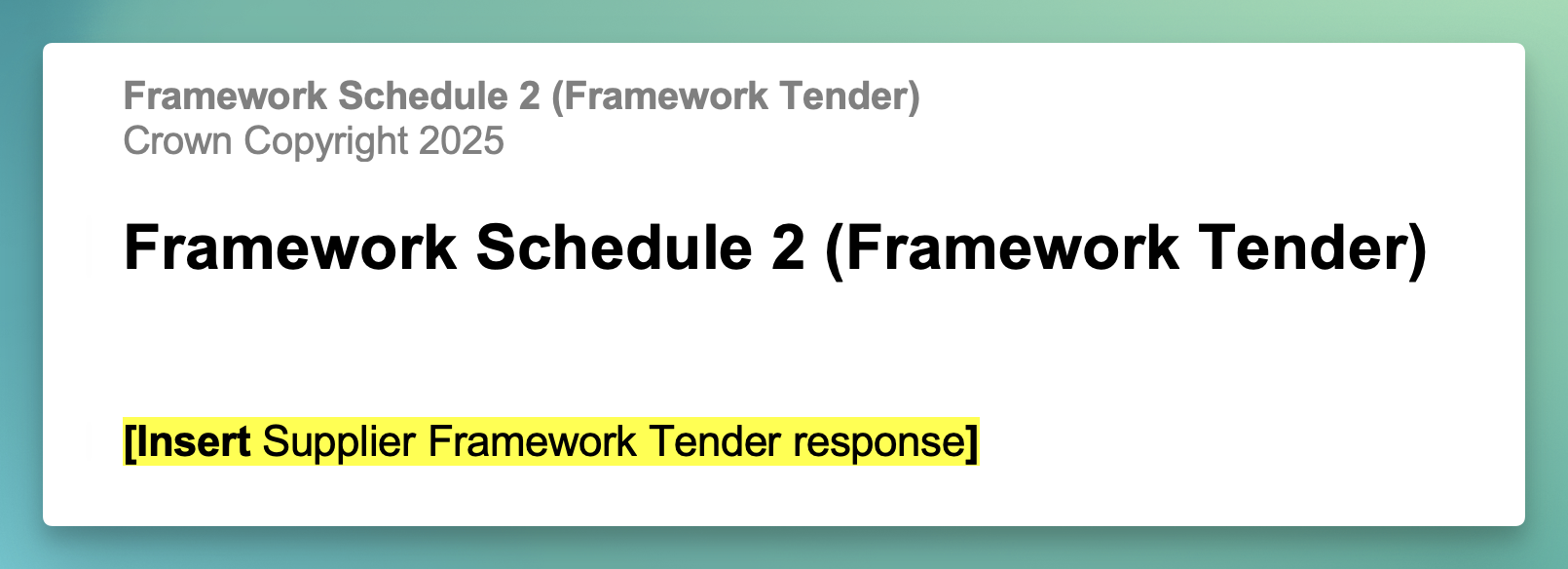
Schedule 2 often causes panic because when you open it, it looks almost empty. Usually it just says something like:
“Insert Supplier Framework Tender Response”
Example of text included with Framework Schedule 2 document
Nothing is missing. Schedule 2 is a placeholder for your entire tender submission. Once the framework is awarded, the buyer takes:
your written responses
your pricing
your technical submissions
and inserts them into Schedule 2, locking them into the contract.
How your tender becomes part of the contract
A ring binder example really helps here. Imagine everything is printed.
For each awarded framework, the buyer has a ring binder with subject dividers labelled Schedule 1, Schedule 2, Schedule 3, and so on. Behind each divider sit the printed documents that match that schedule.
When you get to the divider for Schedule 2, that is where your entire tender response is filed. That is how your tender becomes part of the contract.
What actually makes up the framework contract
Once awarded, the framework contract consists of:
the Framework Award Form
the Framework schedules
the Joint schedules
the General Terms
Schedule 2, which contains your tender response
Together, these documents form the framework contract.
Call-off schedules sit underneath this. Each call-off creates its own job-specific contract but is governed by the framework above it.
They only come into play when a buyer is ready to buy something, and they add the detail for that specific requirement, things like scope, pricing, timelines and delivery. Each call-off creates its own contract, but it always sits under, and is governed by, the framework contract.
That’s why call-offs usually include wording along the lines of: “In the event of conflict, the call-off takes precedence…” Because both the framework contract and the call-off contract are legally binding, they just operate at different levels.
In simple terms:
the framework sets the rules
the call-off creates the job
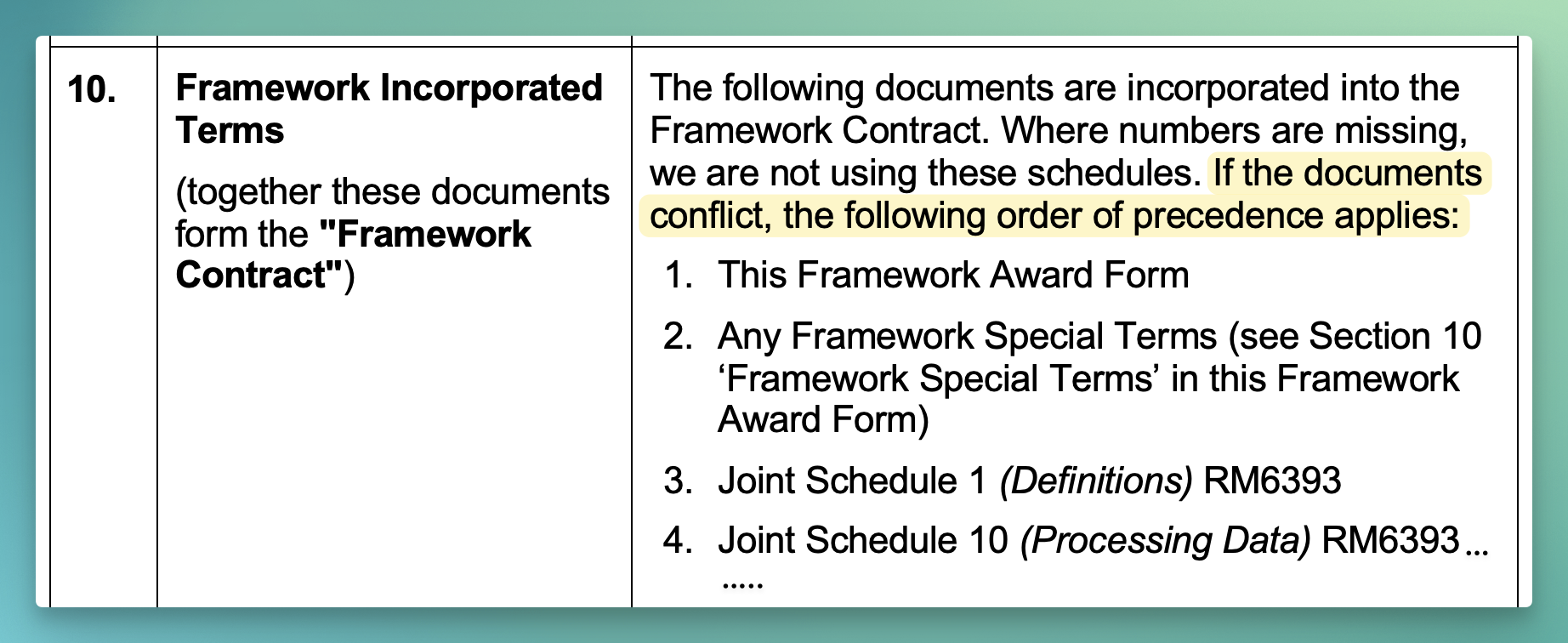
Part 10 of the Framework Award Form
Where should you start reading?
Start with the Attachments. Begin with Attachment 1, then Attachment 2.
In this case, the buyer has been very clear. Paragraph 2.3 explains the reading order and confirms that Attachment 1 and Attachment 2 should be read first.
Paragraph 8 of Attachment 2 How to Tender then sets out what each attachment is, what needs to be done, and who is responsible for each one, in order to submit a compliant tender.
This section is a really useful checkpoint to make sure you are approaching everything correctly.
Why Attachment 6 is not a separate document
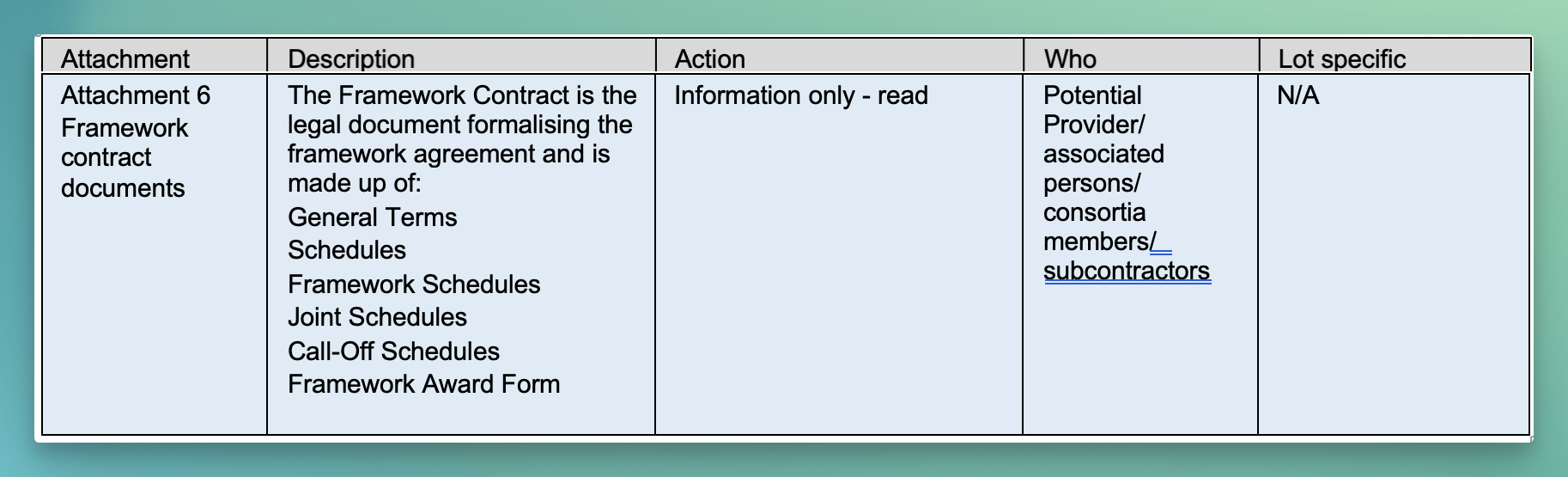
You might notice a reference to Attachment 6, even though there is no separate document called Attachment 6.
Table 1 of Section 8.1 of Attachment 2 How to Tender
That is because Attachment 6 is made up of:
the General Terms
all the schedules
the Framework Award Form
It is essentially the contract pack.
The two ring binders that explain everything
Think of it like this.
Ring binder one – the supplier’s tender file
Created by you. Used purely for tendering. Organised by Attachments. Attachment 6 contains all the contract documents (i.e. schedules) for reference.
Ring binder two – the buyer’s framework contract file
Created by the customer if you are successful. Organised by schedules and contains the schedules that make up the framework contract. Your completed tender is filed behind Schedule 2.
One final thing you really need to know
With frameworks, the contract does not start when you win a call-off. It starts when you are awarded a place on the framework. From that point:
you already have a live contract
you are bound by what you wrote in your tender
you just do not have any work yet
That is why the schedules are not just background paperwork. They set the rules, capture your commitments, and define what you have agreed to deliver.
Schedule 2 is the one that quietly turns: “This is how we would deliver” into “This is how we must deliver”
That is the TacSys tender document pack explained.
Good luck with your submission!
Still need help?
Want help applying this informtion - get in touch now!